Agents your complianceteam can sign off on.
Build, run, and govern AI agent workflows across your existing systems. Runs resume after a crash, people approve the risky steps, and every decision goes into a tamper-evident log.
Source-available under BSL 1.1. Adapters for Anthropic and OpenAI-compatible APIs.
A run, up close
Watch the work, then approve it.
A KYC agent plans its steps, calls tools, and checkpoints as it goes. Before it creates a case, it stops and asks.
{
  "customer": "C-20418",
  "risk": "medium",
  "attachments": 2
}Product demo
See it end to end.
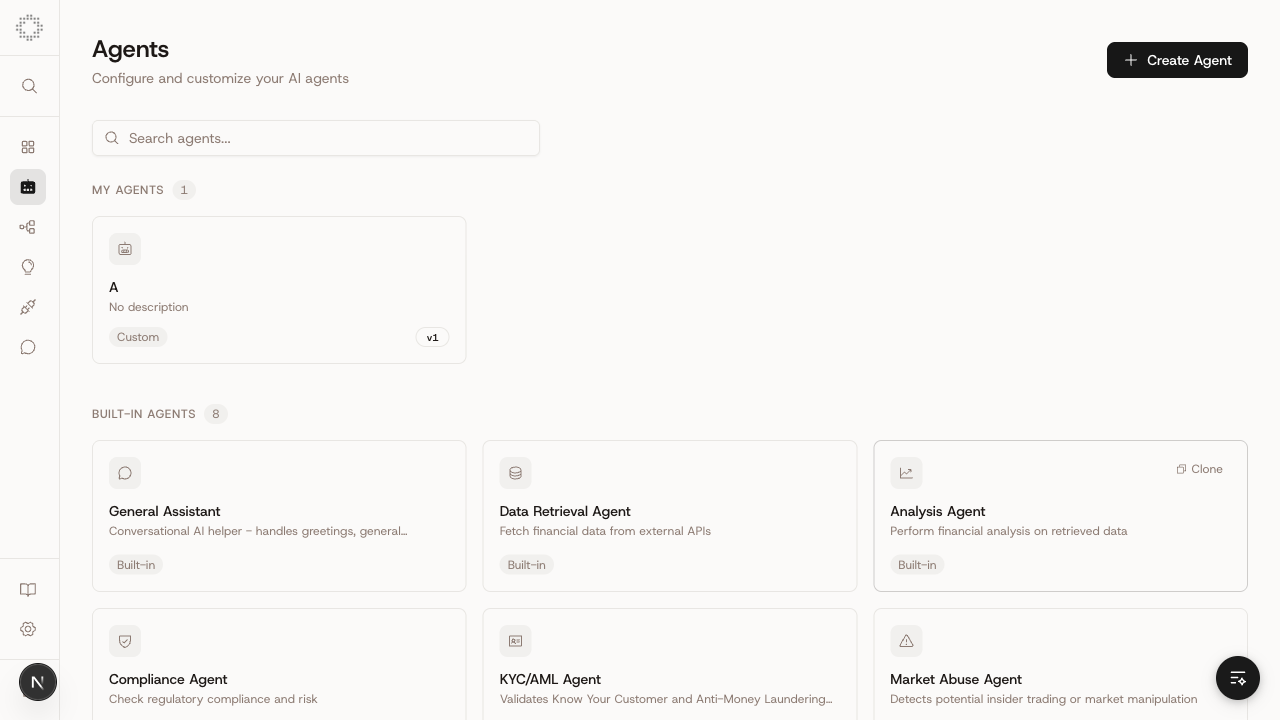
The harness
Runs that survive restarts and stay supervised.
Oniva Agents runs on a durable agent engine, written from scratch in TypeScript with Postgres as the system of record. It is what keeps a long run alive and a person in charge of it.
Durable steps
Every model turn and tool call is a task stored in Postgres. After a crash or restart, a new worker takes over the session and reopens the run from committed state.
Side effects happen once
One worker holds the session lease, and every write carries its token, so a worker that lost the lease cannot commit or run a tool. Tool calls carry an idempotency key and a retry replays the stored result. If a write times out with none stored, the run reports the outcome as unknown rather than guessing.
People in the loop
A tool call can wait for approval, or the agent can ask a question. You can steer a run in flight or queue a follow-up. Waits are stored, so they survive a restart and hold no worker.
Long runs stay usable
An agent can hand a task to a subagent, with depth capped. Old turns are summarized before the context window fills, and prompts use cache breakpoints on Anthropic models, including through OpenRouter.
Policy on every call
A per-tenant policy decides each tool call: allow, block, or require approval. Unknown tools are blocked. After a run reads untrusted content, outward writes need approval. Web-fetching tools reject private addresses and re-check every redirect.
Any model, honest costs
Adapters for Anthropic and OpenAI-compatible APIs, including OpenRouter, with the provider and model set by tenant policy. Usage goes through a durable outbox and is de-duplicated, so a restart does not lose or double-count it.
The engine is switched on per deployment. It runs chat and Deep Work today; Fleet and workflow runs are being moved onto it.
Deep Work
Research that shows its sources.
For questions too big for one pass, several agents work together and the answer comes back as a cited report. Deep Work runs on the engine, so it inherits restart recovery, approvals, and usage accounting.
1. Plan
An orchestrator splits the question into sub-queries and starts a round of workers, up to 10 per round by default.
2. Research
Workers run in parallel as separate conversations. Each searches, reads, and saves findings together with their sources.
3. Reflect
After each round a reflector scores coverage and lists gaps. Gaps can start another round, up to 3 reflection rounds by default.
4. Report
The report cites numbered sources. A deterministic lint blocks citations that point at a source that does not exist and flags sections with factual text but no citation.
Evals
Evals you can trust.
Changes to the agents are scored on repeated runs against recorded inputs, and a regression fails the build.
Repeated trials
Each task runs several times. Reports show pass@k (passes at least once) and pass^k (passes every time), plus cost per passing run and latency.
Recorded web, offline runs
Search and page fetches replay from recorded fixtures. A request with no fixture fails as a miss and never reaches the network.
Code and trajectory graders
Deterministic checks read the trace: which tools ran and in what order, limits, run errors, and the citations in the report.
Judges that must earn their vote
An LLM judge gates a build only after it matches human labels, with true-positive and true-negative rates both at least 0.85. Change the judge prompt and the calibration goes stale, so it stops gating.
A regression gate in CI
CI compares results with a committed baseline. It fails on a pass-rate drop beyond 5 points or two standard errors, a cost per pass up more than 15%, a gating grader that newly fails, or a missing task.
Graders that are tested too
A mutation check injects known faults into recorded traces: dropped citations, exceeded limits, wrong tool order, run errors, cost blowups. It fails if the grader meant to catch a fault does not.
CI runs in fake mode: a scripted model and replayed web, which tests the harness and graders rather than model quality. Judge calibration and live runs against real models are run on demand, and live runs refuse to start without a spend cap.
Platform
From prompt to a decision you can defend.
Visual workflow builder
A canvas with more than 25 node types: agents, logic, transforms, data processing, and integrations. Execution streams onto the canvas as it runs.
Checkpointed workflow runs
Workflow steps are checkpointed in Postgres, so a restart resumes from the last checkpoint instead of starting over.
Tamper-evident audit log
Decisions go into a hash-chained log. Each entry is signed through a pluggable key-management (KMS) interface, verification finds the first broken link, and retention defaults to 7 years.
Connectors
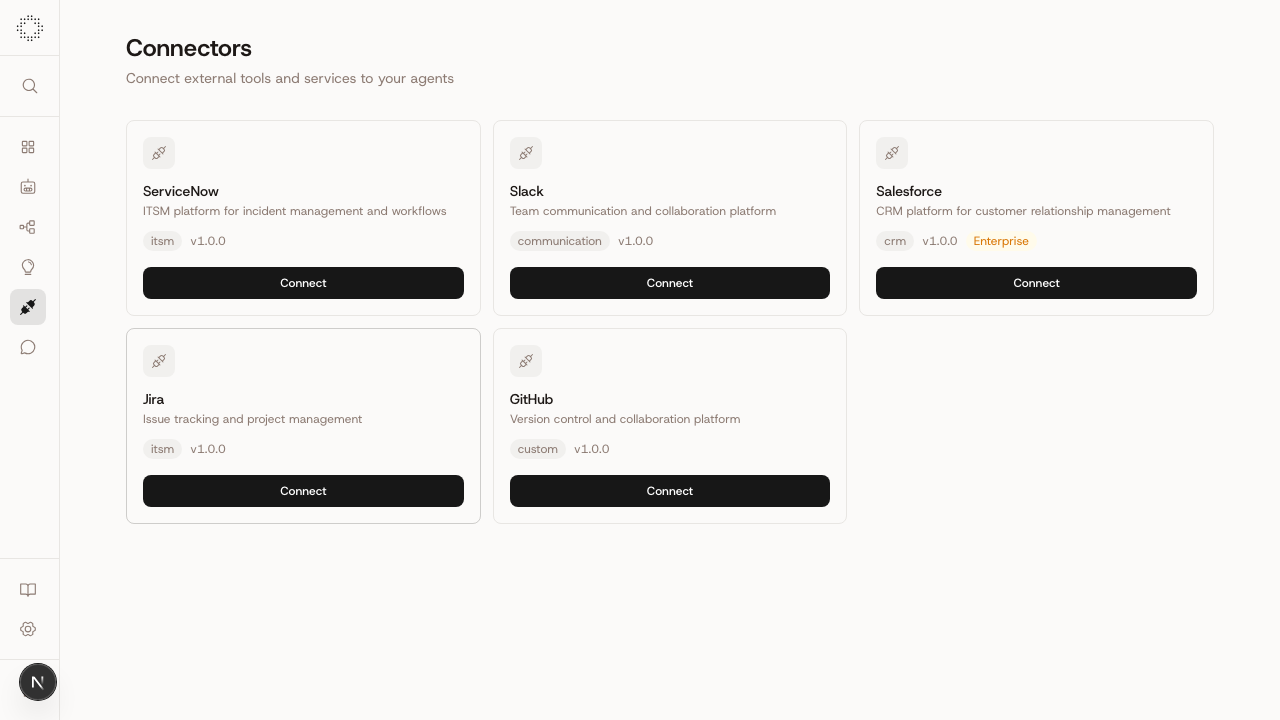
OFAC sanctions screening, 31 curated OpenAPI connectors, and a factory that turns any OpenAPI spec into a tool that runs in an isolated sandbox. Spec and API fetches are SSRF-protected.
Tenant isolation
Postgres row-level security keeps every tenant's workflows, runs, and data separate at the database, not just in application code.
Human in the loop
Approval queues for high-risk steps. A reviewer sees the tool call and its arguments before anything runs.
Session and long-term memory
Agents keep a plan and to-do list for the session, and recall past decisions across sessions with hybrid semantic and keyword search.
Test cases and deploy gates
Agent versions run against test cases and pass deploy gates before they go live, so a change to a live agent is a decision, not an accident.
Schedules and webhooks
Start workflows on a schedule or from a webhook, with logs for every run.
Production signing requires configuring a KMS backend. ServiceNow and Microsoft Teams connectors are in development.
25+
node types on the canvas
10
research workers per Deep Work round, by default
31
curated OpenAPI connectors
7 yr
default audit log retention
In preview
Coming next.
These are built and in review. They are not released, and they are off by default.
Tiered context management
Offload large tool results to files, replace stale results with stubs, and summarize old turns into structured sections.
Richer subagent results
Typed worker results, labelled workers, and a verifier step before Deep Work finalizes a report.
Project memory
Memory per project, kept by a curator, with a playbook, a review queue for new entries, and protections against memory poisoning.
Use cases
Built for operations, risk, and compliance.
Pull customer data from core systems, screen against OFAC, and draft a reviewer-ready case file. Every step is logged, and a compliance analyst approves before anything is filed.
FAQ
Common questions.
Source-available under the Business Source License 1.1. Converts to Apache 2.0 in 2030. Commercial license on request.
Get started with Oniva Agents.
Leave your work email. We will help you set up, from one pilot workflow to production.